The Courage of Birds: Surviving Winter
Book Review by Mary Ann Reuter, Golden Eagle Audubon Guest Blogger
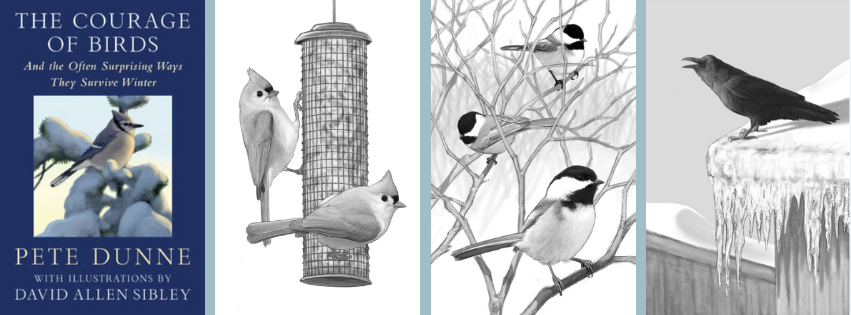
Illustrations by David Sibley
Emily Dickenson suggested that “Hope is the thing with feathers,” but for Pete Dunne that feathered thing - the bird - is courage embodied. Throughout the book, The Courage of Birds: And the Often Surprising Ways They Survive Winter (by Pete Dunne with illustrations by David Allen Sibley; Chelsea Green Publishing, 2024), Dunne’s respect for the resilience and adaptability of winter birds is on full display.
The author of more than twenty highly respected nature books, including The Sibley Guide to Birds, Dunne is decades deep into birds and birding. You might expect his amazement to fade at their fortitude and ingenuity as they meet the challenges of winter. Not so.
Sibley’s gray tone sketches of these mostly familiar birds reveal a softness too. While the illustrations don’t necessarily match the birds described in the text, they are evocative enough to stand alone, suggesting winter’s quiet, minimalistic beauty.

Illustration by David Sibley
Feathers & Fortitude
Taken as a whole, The Courage of Birds is structured into distinct parts that each serve a different purpose. The main section, titled “Birds in Winter,” describes the variety of evolutionary strategies that birds — from the northern-most residents to the longest-distance migrants — use to survive winter and reproduce in spring. In the next section, the “Selected Species Profiles of North American Birds” Dunne focuses on individual species, identifying the specialized ways they have adapted over millions of years to changes in habitat and climate.
In the book’s appendix “Where the Birds Are,” Dunne divides North American bird species into four tiers based on their migratory or resident behavior. Tier 1 (Northern Residents) includes 49 species, Tier 3 (Intermediate Migrants) has 69 species, and Tier 4 (Long‑Distance Migrants) accounts for 67 species. But the largest group by far is Tier 2 (Residents and Short-Distance Migrants) with 478 species. This is great news for winter birders like me, since most of the species likely seen in colder months come from this large, locally present group.
The Migrant’s Journey

Illustration by David Sibley
Dunne’s sly humor is sprinkled throughout the astounding factual content, such as that birds have remarkable memories because of a seasonally enlarged hypothalamus. “So cerebrally endowed are chickadees that the birds can store and remember the hiding places of up to half a million seeds and insect larvae.” He pokes, “Consider that the next time you go searching for your car keys.”
While incredibly knowledgeable about birds and their behavior, Dunne’s discipline as a writer avoids the heaviness of some scientific writing, leaving his prose as refreshing as a winter morning. In 176 pages he succinctly covers what other authors take 300 pages or more to convey about winter ecology. The chapters are really subheads to the larger story, tightly organized in a logical flow. I read this captivating book in one sitting.
The ten pages devoted to “Owls and Winter Owling” felt like a departure from the earlier narrative style however, resembling more of a field guide to various nocturnal raptors. Since I’m a devoted fan of owls I didn’t mind a bit. The “Selected Species Profiles” continues the same expository style, almost creating a separate book within the book.
Nonetheless, the author brings the overarching message home in the epilogue, reminding us that dinosaurs evolved into feathered birds, able to survive winter and successfully reproduce in spring. “Far from frail creatures at the mercy of their environment, birds have proven themselves to be hardy survivors whose fortitude and ingenuity permit them to surmount winter’s challenges,” Dunne marvels.
Conservation Call to Action
At several points in the book, Dunne describes National Wildlife Refuges as a national treasure of protected habitat, especially important for migrating birds. Indeed, they are peaceful places to observe winter birds. However, in his enthusiastic support for public lands, he avoids mentioning that hunting is allowed in some of these safe havens.
Still, a much bigger threat for birds and other wildlife is the degradation expected when conservation protections for refuges are removed altogether. Since the book was published, Congress is considering a resolution to open the Arctic National Wildlife Refuge (the largest national wildlife refuge in the U.S.) and the Western Arctic in Alaska to oil drilling.
In The Courage of Birds, Dunne not only celebrates the grit and ingenuity of winter birds, but also subtly reminds us of our own responsibility: these feathered survivors depend on more than just evolution — they depend on habitat, on protection, and on respect. As Congress battles over places like the Arctic National Wildlife Refuge intensify, Dunne’s work feels especially urgent. The very species he admires — from chickadees with photographic memories to migratory flocks that span continents — face real-world threats tied to policy and land use. By turning the last page, readers are left with more than admiration: there is a call to act, to support conservation, and to preserve the wild places that allow birds — and all of us — to endure.
Note: The National Audubon Society and other conservation groups insist these areas be protected from industrial development. You can join them by asking your members of Congress to uphold protections for America’s Arctic.