Introduction to Fire Ecology
By Louisa Evers, Golden Eagle Audubon Board Member
Earlier I discussed the basics of fire behavior and types of wildland fire. These are the foundations for understanding fire ecology. Fire ecology is the study of how wildland fire interacts with the environment. The environment includes plants, animals, soils, air, and just about everything out there. There are entire college degrees devoted to explaining fire ecology so I will just cover some basic concepts. This blog will focus on fire regimes.
Fire Regimes
A fire regime is defined by the frequency, severity, extent, timing, and synergistic effects in the future with the next fire as well as other disturbance types, such as insect outbreak or disease epidemic. Most often fire ecologists focus on frequency and severity, somewhat on timing, and less so on extent and synergistic effects. Timing refers to the time of year when fire would be expected, and while we may think of that as strictly summer, when Indigenous burning practices are included, it could also mean spring and fall. Extent refers to the average size of an individual fire or the range of variability around average fire size.
Fire frequency can be measured several ways. The most common measures are fire rotation and fire return interval. Fire rotation is the length of time needed for an area equal in size to the study area to burn. Fire return interval is the number of years between two successive fires burning in the same area. These two measures often give different fire frequencies. Fire return interval, or more accurately average fire return interval, is the more commonly used measure in research. The average is simply the arithmetic average of all fire intervals in an area.
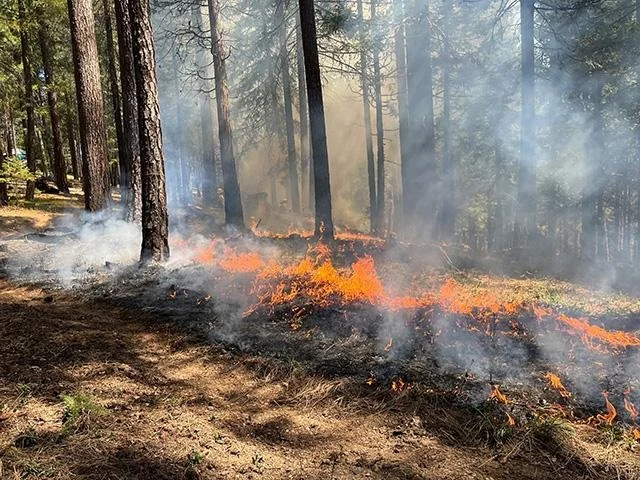
Figure 1. Low severity fire burns needles, grass, and some understory vegetation with low flame lengths.
Fire severity is the measure of the impact of a fire on some element of the environment. When considering the impact of a fire on plants, animals, and soil, for example, the same fire can have differing fire severities, especially at the species level for plants and animals. The most common element used in measuring or discussing fire severity is the impact on plants, primarily the dominant species or species group (e.g., Douglas-fir or conifers). Older research documents often conflate fire severity and fire intensity and use very vague terms such as “hot” or “cool” without defining them. Fire intensity is the amount of heat or energy released by the fire as it burns, usually some average value.
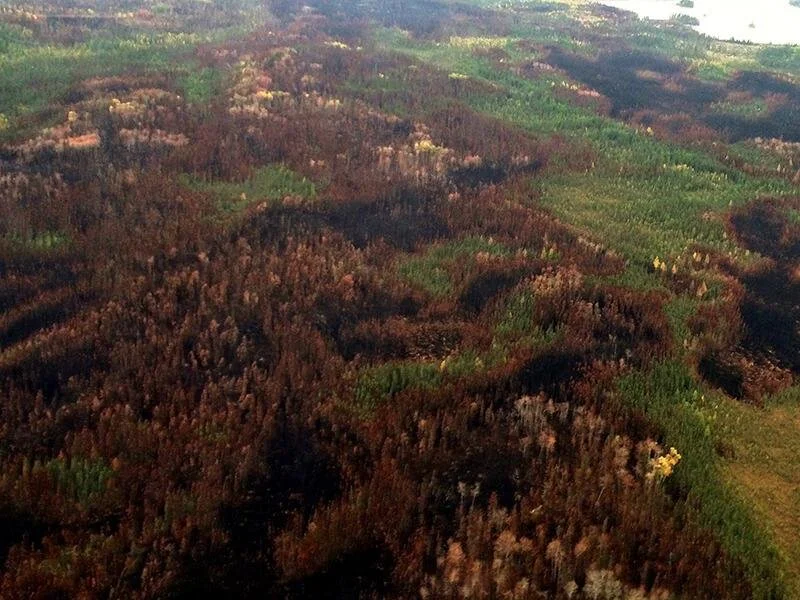
Figure 2. Mixed severity fire consists of high severity patches of varying size interspersed with low severity patches.
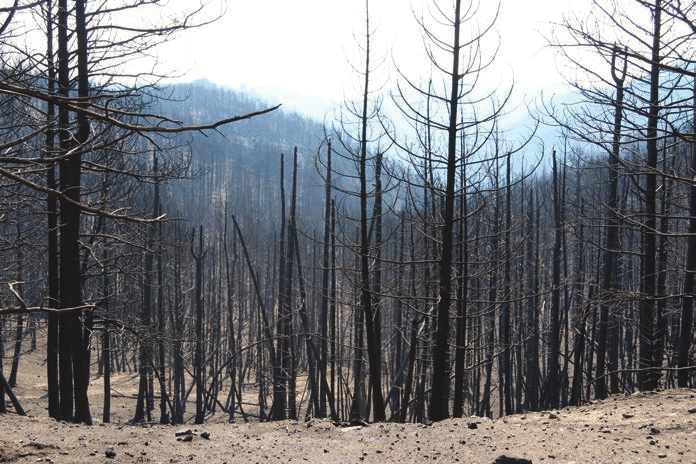
Figure 3. High severity fire results when the dominant vegetation is killed over most of a landscape.
Fire severity is usually classified as Low, Moderate or Mixed, and High. In a low severity fire 25% or less of the overall vegetation is killed or top-killed (Figure 1). By top-killed, I mean the aboveground portion of plant species that resprout may be killed or consumed by the fire, but the plant comes back from underground parts. In a Moderate or Mixed severity fire 25-75% of the vegetation is killed or top-killed (Figure 2) and in a High severity fire over 75% of the vegetation is killed or top-killed (Figure 3). These are the definitions used by LANDFIRE, the system used nationally and internationally to analyze and discuss fire regimes.
Fire extent is the size of the fire. We have good data for fire sizes back to about 1980 in forests, and back to about 1990 in rangelands. Prior to those dates, we have only anecdotal evidence of fire sizes, although in high severity fire regimes in forests, the age of forest stands, and aerial photography can help determine fire sizes. However, aerial photography data extends only to about 1930 to 1940, depending on the location. In rangelands, we have little to no information on fire size prior to 1990. Reports indicating increases in fire size are limited to analyzing fire size in recent years.
Fire timing has most often referred to fires occurring in summer in the West and sometimes extending into early fall. However, Indigenous peoples conducted most of their burning in late winter, spring, and late fall. Like us, they wanted to control how much area burned and where the fire went when they used fire to drive game, clear travelways, reduce fire risks at frequently used campsites and seasonal camps, and manage species for food, medicines, and materials such as basketry.
Fire Regime Descriptions
Several approaches to describing fire regimes have been developed over the years; LANDFIRE fire regimes are the accepted approach used by the federal, state, and tribal governments to describe fire regimes. The original LANDFIRE fire regime descriptors consisted of five broad groups (Table 1). Fire regimes I, III, IV, and V described forest fire regimes and all other vegetation types were lumped into Fire Regime II.
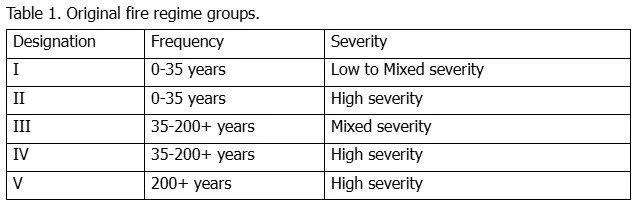
These categories were quite broad. Limiting all non-forest vegetation types to a single group was not an accurate reflection of historical fires across such a wide range of vegetation types. Other issues developed over the broad range of years included in Fire Regimes III and IV and the indefinite upper range. Even with Fire Regime I, issues arose over how to best characterize the severity given the range of years.
One significant problem is the human need to create definite categories concerning things that occur over a continuum with no clear breakpoints. The definitions used for the degree of mortality in low, mixed, and high severity are, of necessity, arbitrary, as these categories blend from one to the other. In addition, patch size matters in determining how the fire affects plants, animals, and soils. In general, the longer the average return interval, the larger the expected vegetation replacement patch size.
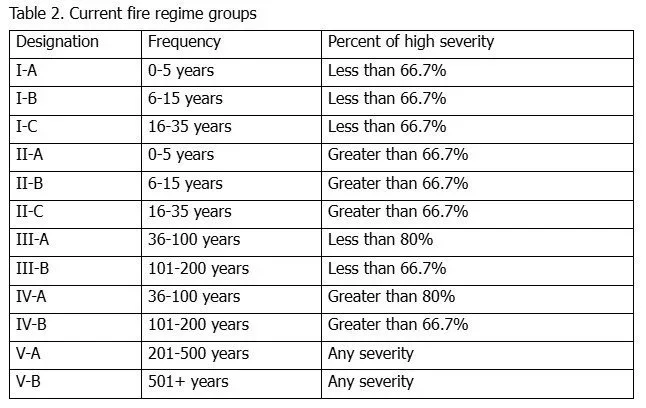
As a result, historical fire regimes were further refined in the 2016 LANDFIRE mapping effort (Table 2). Each general fire regime class was subdivided with clear upper endpoints in the number of years within each frequency and an indication of the percentage of replacement, or high, severity fire expected. Fire regimes are also tied to specific biophysical settings (the pre-European colonization vegetation). As a result, the fire regimes of non-forest vegetation types can be better represented, and federal and state land managers can better assess how current conditions differ from historical conditions.
Editor’s Note: Louisa has a professional background in fire ecology and many years experience assessing fire risk and predicting fire behavior. Read her previous blogs for more information.
July 25, 2026 Wildfire a Primer on Behavior
August 25, 2025 Fire Behavior Triangle
October 29, 2025 Types of Wildland Fires